Art and Science Together Creates “STEAM”
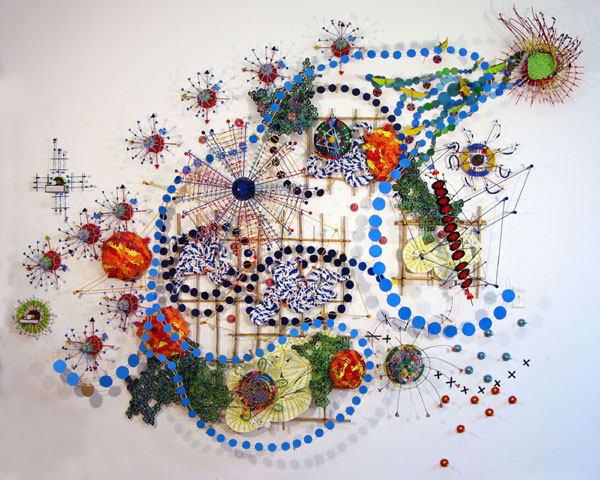 |
| "Nathalie Miebach focuses on the intersection of art and science and the visual articulation of scientific observations." Taken from www.ritholtz.com. |
Science
has always fascinated me. I love learning new concepts and
understanding how they apply to my life and everyone around me.
Science, for the most part, is able to explain how and why things
happen inside our bodies and around us. It also shows how these two
systems relate and affect each other. So if science is so interesting
and amazing, then why is it so difficult to teach it to our students? In
teaching science, the biggest challenge is how to motivate the students
and inspire them to study and appreciate science. There are a lot of
scientific terms they need to know and understand. They are big words
that they probably heard for the first time like Adenosine Triphosphate
or Deoxyribonucleic Acid. How can we prevent our students from being
scared and shut down after hearing these complicated words and concepts?
How can we maintain their motivation? How can we ensure that these
concepts will be retained after they leave the classroom or after a
whole year of science class?
There
are a lot of challenges to overcome, but I believe that if students
experience science then it will help educators to answer these
questions. Laboratory experiments, field trips, projects are ways to
experience science. Science teachers use these strategies, but they are
still not enough to answer these questions. In 2008, DANA Arts
Cognition and Consortium organized and assembled different scientists
from multiple Universities to conduct a study if the use of Art affects
other areas of learning. The study indicated that there were
improvements in math and reading scores, attention, cognition, working
memory and reading fluency (Pomeroy 2012). There is another study by
the National Endowment for the Arts where they found out that students
from low socio-economic backgrounds show better scores in science and
writing if they actively participated in the Arts (Chen and Cheers,
2012) as shown in the table below.

I
love Art and I find it very interesting, so I combined these
disciplines that I love in teaching science. It is good to know that
the results in my classroom coincides with the studies I mentioned
above. Sometimes my students will tell me, “Ms. Ferre, I thought this
was a science class, then why does it feel that I am in an Art class?”
The student is not really complaining, he is just curious. I would
tell my students that I love Art, that is why I always use it in class.
After years of teaching, most of the former students that I have talked
to remembered the concepts I taught them. Most especially, the
activities that that have done where they drew pictures, created models,
poems, music, etc. There would always be a part of my lesson where the
students draw a model of the object we are discussing. Examples would
be the cell, types of faults, animals and a lot more. They also labeled
and explained the functions or relationships of their parts and
concepts. They also created models using any materials they can find.
Sometimes, we use food items to create models and the students eat them
afterwards. My favorite activity is when the students drew pictures of
their fictional babies after they combine their dominant and recessive
traits with a classmate. They use the Punnet square to identify the
possible traits and then they finish the assignment by drawing their
babies.
Students
remember these activities and the concepts very well They are
motivated and excited to do these activities as well. They do not feel
bored since they are not just listening and memorizing the terms and
concepts, but they actively engaged but unconsciously absorbing them.
That is why I agree with Debra Shapiro (2010) in her NSTA Report on Reaching Students
Through STEM and the Arts that mentioned, “Teachers
of science, technology, engineering, and mathematics (STEM) are
discovering that by adding an "A" -- the arts -- to STEM, learning will
pick up STEAM."
References:
Chen, Kelly and Cheers, Imani. American Graduate Education (2012, July 31). STEAM Ahead: Merging Arts and Science Education. Retrieved on December 10, 2012 from http://www.pbs.org/newshour/rundown/2012/07/the-movement-to-put-arts-into-stem-education.html
Pomeroy, Steven Ross. Scientific American (2012, August 22) From STEM to STEAM: Science and Art Go Hand-in-Hand. Retrieved on December 10, 2012 from http://blogs.scientificamerican.com/guest-blog/2012/08/22/from-stem-to-steam-science-and-the-arts-go-hand-in-hand/
Ritholtz, Barry.The Big Picture (210, September 30) Art+ Science = Sculptural Data. Retrieved on December 10, 2012 from http://www.ritholtz.com/blog/2010/09/sculptural-data-art/
Shapiro, Debra. NSTA WebNews Digest (2010, January 7). Reaching Students Through STEM and the Arts. Retrieved on December 10, 2012 from http://www.nsta.org/publications/news/story.aspx?id=56924&print=true

Great post this week! Art infused across the curriculum certainly makes learning meaningful. As well as a teacher who is passionate in the classroom. From your post and the research you shared it is evident you are passionate about art integration. Here is an interesting article from ASCD about integration arts in the cirriculum
ReplyDeletehttp://www.ascd.org/publications/newsletters/education-update/mar09/vol51/num03/Making-Content-Connections-Through-Arts-Integration.aspx